Kitchen Drawer Organizers: What Actually Works
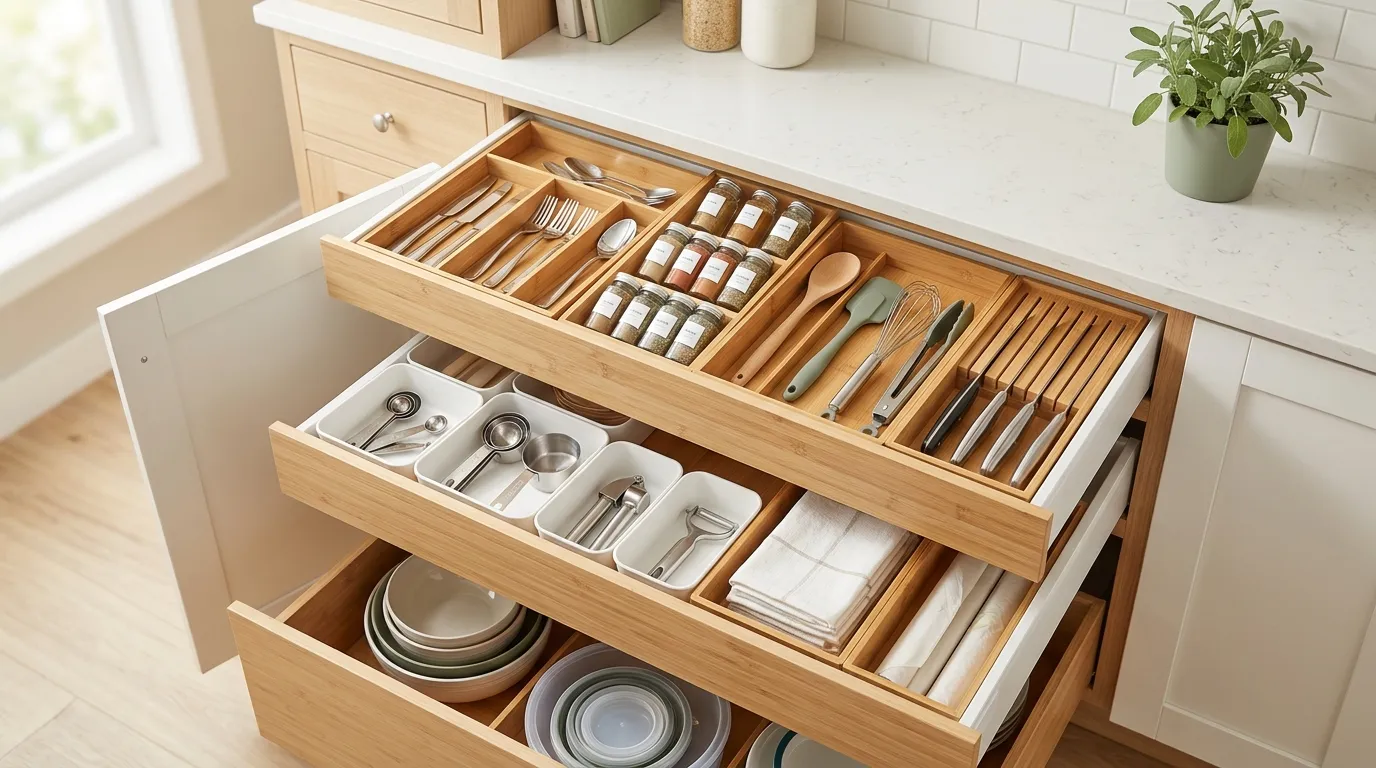
Table of Contents
What is the best way to organize a kitchen drawer? The most effective drawer organization uses adjustable, spring-loaded bamboo dividers for odd-sized cooking utensils, and fixed-compartment bamboo trays for flatware. However, the most critical step is assigning every single drawer exactly one primary purpose before buying any organizers, ensuring no drawer becomes a dumping ground.
Buying expensive drawer organizers will not fix your messy kitchen if the drawer itself has no defined purpose.
If a drawer holds "everything miscellaneous"—from rolling pins to AA batteries to takeout menus—it will defeat any organizer you put inside it within a week. The secret to kitchen drawer organization is ruthless categorization followed by the correct type of divider.
Here is exactly how to assign your drawers and which organizers actually work.
The Drawer Assignment Rule
Before you purchase anything, empty every drawer. Write down exactly what purpose each drawer will serve based on its physical location in the kitchen.
- Drawer nearest the stove: High-use cooking tools only (spatulas, wooden spoons, tongs, ladle, whisk).
- Drawer nearest the prep area: Sharp and precision tools (knives, peelers, microplanes, can openers).
- Drawer for prep accessories: Measuring cups, measuring spoons, digital kitchen timer, meat thermometer.
- Flatware drawer: Everyday forks, knives, and spoons.
- The Single Utility Drawer: You are allowed one "junk" drawer, but it must be heavily divided. Limit it to a single layer of defined categories (pens, tape, batteries). See our Junk Drawer Guide for specific layouts.
The 4 Types of Kitchen Drawer Organizers
Not all dividers are created equal. You must match the type of organizer to the specific tools going inside.
1. Spring-Loaded Adjustable Dividers
These are the most flexible and highly recommended option for the majority of your kitchen. Spring-loaded dividers expand to fit tightly against the front and back of any drawer, creating long, deep channels.
- Best for: Cooking utensil drawers. Utensils like spatulas and whisks vary wildly in length and width. Fixed trays never fit them perfectly, but adjustable dividers allow you to create custom-width channels for your specific tools.
- Material: Opt for solid bamboo dividers over plastic; they look built-in and don't warp under pressure.
2. Fixed-Compartment Trays
Trays with pre-cut, fixed compartment sizes are highly efficient for uniform items. They fill the drawer fully and leave less wasted dead space than individual small bins.
- Best for: Flatware drawers and knife inserts. Because everyday forks and spoons are identical in size, they stack perfectly in fixed slots.
- Pro Tip: To save space, place dessert spoons and tablespoons in the exact same long slot. You do not need separate compartments for them.
3. Deep Drawer Inserts (Two-Tier)
For very deep drawers, items often get piled on top of each other in a tangled mess. Two-tier sliding inserts effectively double your horizontal storage.
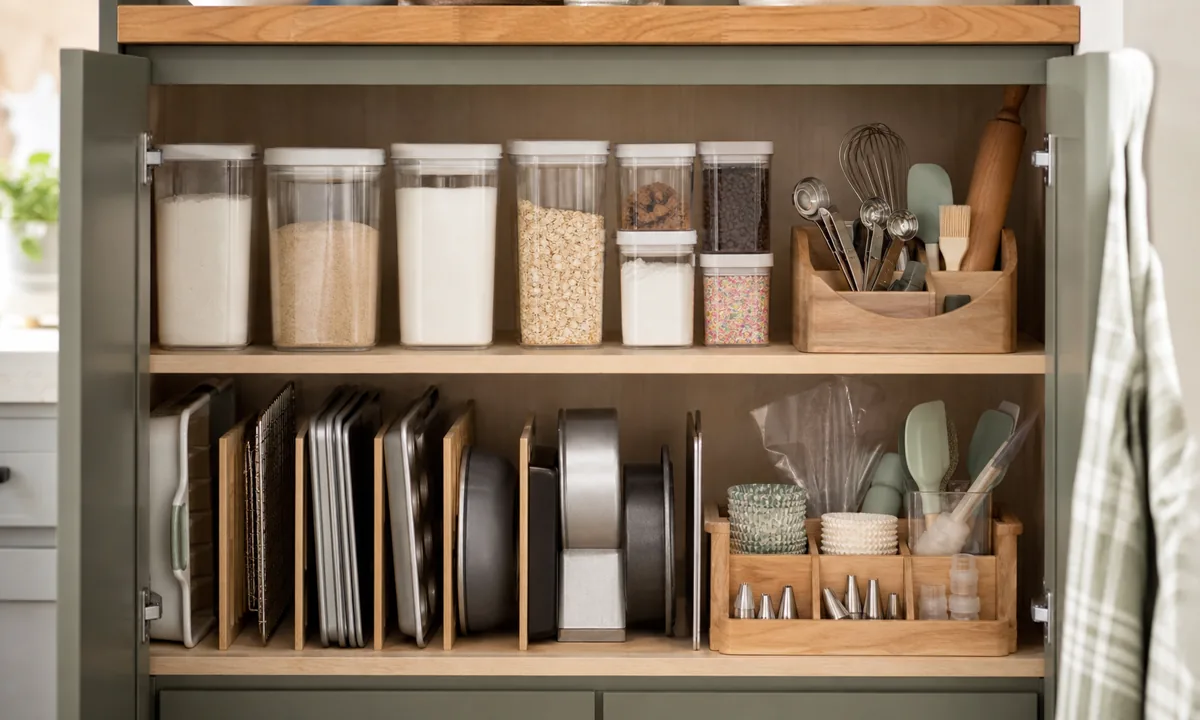
- Best for: Deep drawers holding baking tools or specialty gadgets. The top sliding layer holds frequently used items (like measuring spoons), and sliding it back reveals a second storage layer beneath for rarely used cookie cutters.
4. Pegboard-Style Drawer Inserts
Systems like the IKEA KUNGSFORS or custom wooden peg drawer inserts use a drilled baseboard and movable pegs to create custom, structural compartments.
- Best for: Extremely deep lower drawers designed to hold heavy items like ceramic bowls, plates, or pots and pans. The pegs prevent the heavy ceramics from sliding and smashing into each other when the drawer is pulled open quickly.
The 14-Day Maintenance Rule
Drawer organizers only stay organized if everyone in the house knows the rule.
When you reorganize a kitchen, the muscle memory of your family is broken. They will blindly throw a whisk into the flatware drawer because that's where it used to be.
The Solution: Post a small Post-it note inside the lip of each drawer for the first two weeks noting exactly what belongs in it (e.g., "Prep Tools ONLY"). This visually trains household members on the new system. After two weeks, behavior adapts, the path of least resistance is established, and the drawer will stay organized permanently.
Frequently Asked Questions
How do I measure a drawer before buying an organizer?
How many cooking utensils do I actually need to keep in my drawer?
Do drawer organizers waste valuable space?
Join Organized Haven
Get weekly home organization tips, DIY décor ideas, and exclusive printables delivered straight to your inbox. Join 10,000+ homeowners today!
We respect your privacy. Unsubscribe at any time.
Written by Danilo Souza
Danilo Souza is a Home Organization Expert and Interior Decor Specialist with over 8 years of experience in transforming cluttered, stressful rooms into functional, peaceful, and beautifully designed living spaces. His practical, step-by-step methodologies empower homeowners to create lasting organizational systems that fit their lifestyle and budget.