How to Organize a Junk Drawer That Stays Tidy
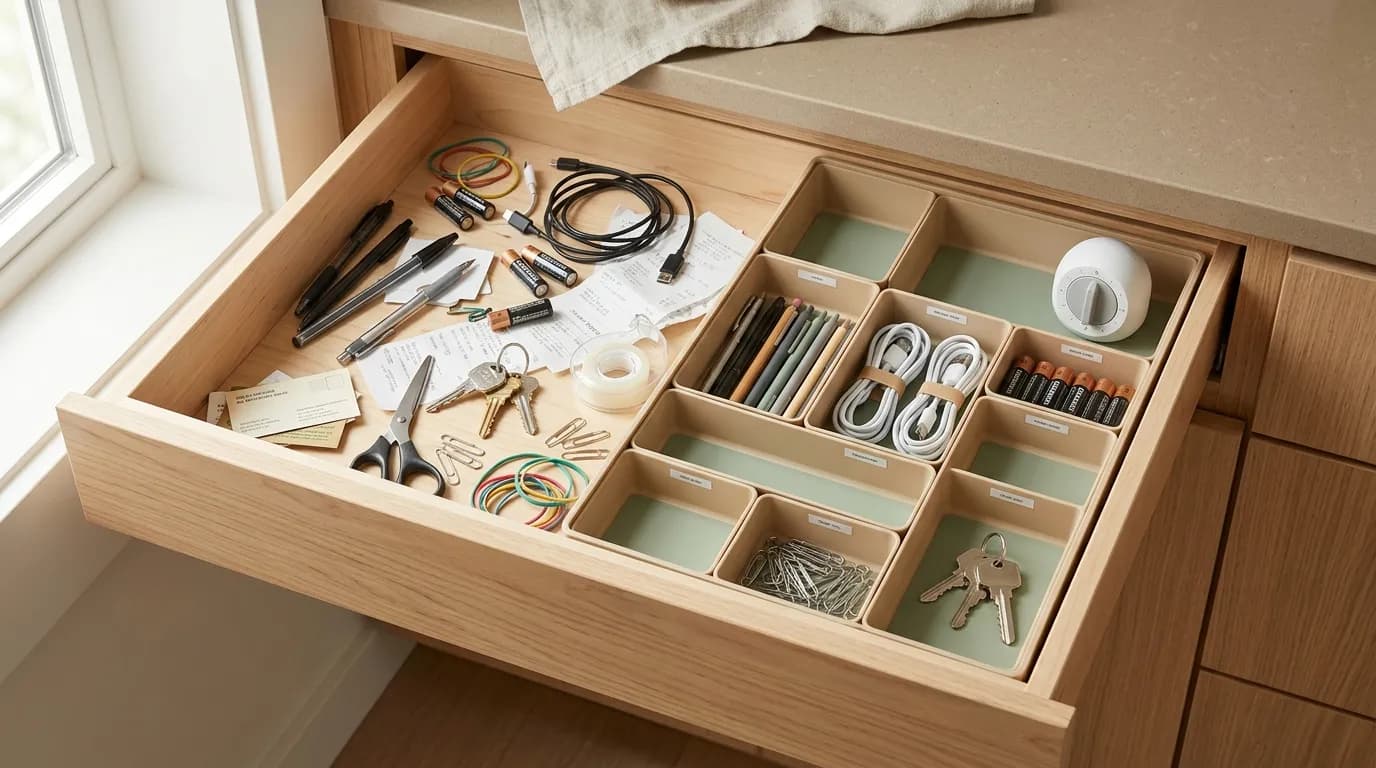
Table of Contents
How do you actually organize a junk drawer? Empty the drawer completely onto a flat surface, throw away anything broken or expired, and group what remains by strict category (pens, tools, batteries, tape). Then assign each category its own section using a drawer divider or small bins, and return only the items that earned their place. Total time: 20 minutes.
The junk drawer exists in nearly every home, and it exists for a legitimate reason—you need a central location for small, miscellaneous items that don't have another natural home. The problem isn't the concept. The problem is the complete absence of categories. When everything goes into one undivided pile, nothing is findable.
The goal isn't to eliminate your junk drawer. It's to give it an internal structure so it can actually serve its purpose.
What You Need Before You Start
- One trash bag
- Small bins or a multi-compartment drawer divider tray (a basic Amazon set works; a repurposed muffin tin works just as well)
- A pen that you actually test as you go
- 20 minutes
That's genuinely all you need. Do not buy anything expensive before doing this. Organize first, shop for better containers afterward if you decide the muffin tin isn't cutting it.
Step 1: Empty the Entire Drawer (3 Minutes)
Pull everything out onto a kitchen table or counter. Do not sort while you're pulling—just get it all out at once where you can see the full scope of what you're dealing with.
Step 2: Trash Everything That Qualifies (5 Minutes)
Before sorting what stays, aggressively remove what goes. Here is the real list of what to throw out right now:
- Every pen you cannot confirm works — test them on a scrap of paper, right now, one by one
- Dead batteries — shake and listen; dead ones sound hollow
- Expired coupons and any receipt older than 90 days
- Random screws with no identifiable source (if you haven't needed them in 6 months, you won't)
- Old takeout menus — they are all online and most of those restaurants may have closed
- Mystery keys that haven't been identified in over a year
- Rubber bands that have hardened or cracked
This step removes 30–50% of the drawer's contents in most homes.
Step 3: Sort the Keepers Into Categories (5 Minutes)
Group what remains into piles by strict category on the table. Do not put anything back in the drawer yet.
Common categories for most junk drawers:
- Writing tools — pens, pencils, markers, one highlighter
- Small tools — mini screwdriver, tape measure, scissors, box cutter
- Batteries — sorted loosely by size (AA, AAA, 9V)
- Adhesives — tape, super glue, one pack of sticky notes
- Cords and cables — only if you cannot identify another home for them
Step 4: Assign Each Category a Zone (5 Minutes)
Use a drawer divider tray or small individual bins to give each category its own defined section. Place the most-used categories nearest the front of the drawer.
The OXO Good Grips or mDesign adjustable divider sets are consistent recommendations for their ability to expand and fit any drawer width. Clear acrylic lets you see each section at a glance without removing anything.
For the kitchen drawer methodology applied to all your kitchen drawers, read our Kitchen Drawer Organizers Guide.
Step 5: The "Return Here" Rule (Ongoing)
The junk drawer stays organized permanently with one enforced rule: every item that enters the drawer must fit into one of the existing labeled categories. If a new item does not belong in any existing category, it either gets its own designated home somewhere else in the house, or it gets thrown away. Nothing enters the drawer without a category.
The 3-Minute Monthly Reset
Once a month, spend three minutes on this drawer. The categories are already defined, the structure is already in place—you are only returning stray items to their sections and removing anything that doesn't belong. Three minutes. Put it on your calendar right now.
Frequently Asked Questions
What actually belongs in a junk drawer?
How do I stop the junk drawer from becoming chaotic again?
How many categories should a junk drawer have?
Join Organized Haven
Get weekly home organization tips, DIY décor ideas, and exclusive printables delivered straight to your inbox. Join 10,000+ homeowners today!
We respect your privacy. Unsubscribe at any time.
Written by Danilo Souza
Danilo Souza is a Home Organization Expert and Interior Decor Specialist with over 8 years of experience in transforming cluttered, stressful rooms into functional, peaceful, and beautifully designed living spaces. His practical, step-by-step methodologies empower homeowners to create lasting organizational systems that fit their lifestyle and budget.