How to Store Emergency Supplies in a Small Apartment Without a Closet
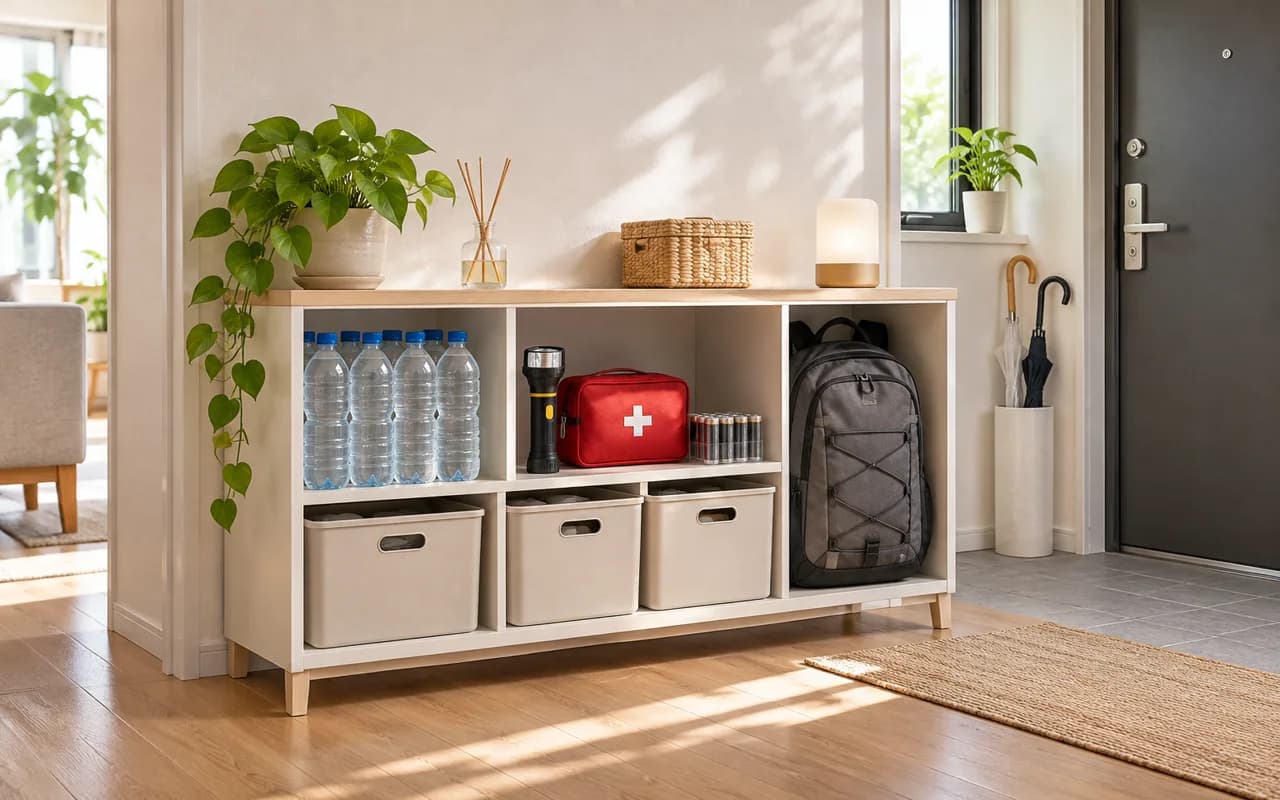
Table of Contents
- Start With the Apartment's Safest Available Space
- Use a Two-Part System Instead of One Giant Tote
- Build the Kit Around Real Apartment Constraints
- 1. Protect the exit first
- 2. Use vertical labels, not buried labels
- 3. Store water in manageable portions
- 4. Give food a rotation path
- 5. Keep special needs visible
- A 20-Minute Apartment Reset
- Common Mistakes That Waste Small-Space Storage
- The Goal Is Retrieval, Not Perfection
How do you store emergency supplies in a small apartment without a closet? Keep one portable go-bag near the exit, place compact home reserves in a low dry cabinet or under-bed bin, and use a short inventory card with review dates. Do not store supplies in an exit path, on a high unstable shelf, or where heat and moisture can damage them.
Small-apartment preparedness is mostly a placement problem, not a shopping problem. A large plastic tote full of random items can feel reassuring until it blocks the only coat closet, becomes too heavy to lift, or disappears behind seasonal décor. A useful apartment emergency kit has a clear job: the essentials can leave with you, the home reserve stays protected, and everyone in the household knows where both live.
This guide targets the long-tail question how to store emergency supplies in a small apartment without a closet. It is intentionally different from a full emergency supply closet system: here, the constraint is limited floor area, shared walls, elevator access, and the need to keep exits clear.
Start With the Apartment's Safest Available Space
Before choosing bins, walk through the apartment as if you needed to leave quickly. The best location is usually a low cabinet near—but not in—the entry route, a dry section beneath a bed, or the back of a sturdy hall cabinet. The best-looking spot is not always the safest one. Avoid placing a heavy kit above shoulder height, beside a heat source, below a leaking pipe, or directly in front of a door.
Ready.gov's basic supply kit checklist is a helpful starting point, but it should not dictate one oversized container. The agency also advises households to adapt kits to their own needs. In an apartment, that means accounting for pets, prescriptions, mobility needs, children, building access, and local risks before deciding how much space each category deserves.
Use a Two-Part System Instead of One Giant Tote
The most practical small-apartment emergency supply storage system separates what must travel from what can remain at home.
| Zone | What belongs there | Good small-space location |
|---|---|---|
| Go-bag | Copies of contacts, first aid, chargers, flashlight, essential medication plan, snacks, light layer | Beside the entry inside a cabinet or on a low hook rated for the weight |
| Home reserve | Water, shelf-stable food, sanitation items, batteries, pet items, backup lighting | Low cabinet, under-bed container, or sturdy bottom shelf |
| Document pouch | Insurance details, building contacts, identification copies, medical information | Water-resistant pouch inside the go-bag or locked accessible drawer |
A backpack is better than a deep bin for the portable core because it answers the most important question immediately: what leaves with us? Keep it light enough for the person expected to carry it. A home reserve can be split across two shallow containers; that is easier to rotate and safer to move than one packed crate.
Build the Kit Around Real Apartment Constraints
1. Protect the exit first
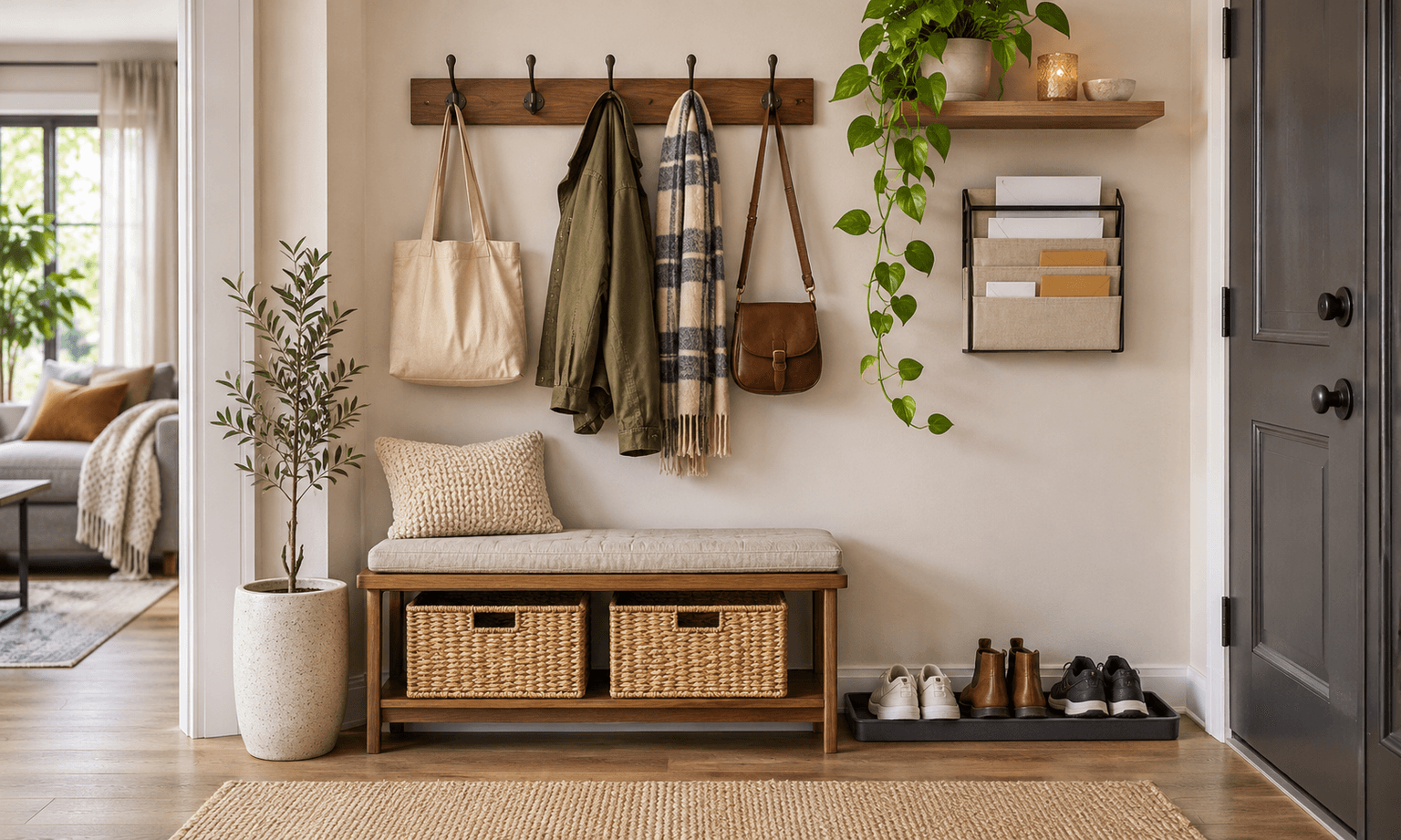
Never turn the doorway, hallway, or balcony access into storage. A kit belongs near an exit only when it does not narrow the route. Put shoes, coats, and daily bags in their own entryway drop zone so the emergency kit cannot become the default landing place for ordinary clutter.
2. Use vertical labels, not buried labels
In a narrow cabinet, labels on the lid are invisible once containers stack. Label the front edge with broad functions: “light,” “first aid,” “food,” or “pet.” A paper inventory taped inside the cabinet door is enough; it does not need an app or a color-coded spreadsheet.
3. Store water in manageable portions
Water is dense, so a single large container can be hard to carry and difficult to fit. Use multiple smaller containers that stay within the weight a household member can safely lift. Keep them low and inspect them during the same monthly routine used for your freezer inventory.
4. Give food a rotation path
Choose shelf-stable items your household already eats, then place the newest items behind the oldest. When an item reaches its review date, use it in a normal meal and replace it. A kit is not a museum display; rotation is what keeps it useful.
5. Keep special needs visible
Prescriptions, infant supplies, mobility tools, and pet items should not be hidden inside a generic “miscellaneous” bin. The details vary by household, which is why a personal list is more valuable than copying a viral kit checklist. For pet-specific storage, see how to organize pet supplies.
A 20-Minute Apartment Reset
Use this sequence once a month, or at the start of a severe-weather season:
- Stand at the door and confirm the exit route is open.
- Lift the go-bag and check that its weight is manageable.
- Test the flashlight and replace depleted batteries.
- Read the dates on food, water, and medicine-related items.
- Update the contact card if your building manager, school, veterinarian, or emergency contact changed.
- Return the kit to its assigned space before handling any other organizing task.
The final step matters. If the cabinet is used as a temporary holding area for packages, reusable bags, or cleaning supplies, the emergency system will slowly dissolve. A visible boundary makes the category easier to defend.
Common Mistakes That Waste Small-Space Storage
Using one opaque bin for everything. It hides what is missing and makes the entire kit hard to carry. Split portable and stay-at-home supplies.
Buying water or food without a rotation plan. Expiration dates do not organize themselves. Use items your household will genuinely consume.
Storing the kit above the refrigerator. High, warm, hard-to-reach spaces look convenient but work poorly in an urgent situation.
Forgetting building-specific information. Apartment dwellers may need a paper building address, management contact, stairwell plan, and pet information when phones are unavailable.
The Goal Is Retrieval, Not Perfection
Emergency supply storage in a small apartment works when it is calm, accessible, and current. You do not need matching bins or a spare closet. You need a portable core, a protected reserve, open exits, and a simple review habit. Start with the available cabinet or under-bed space, then let actual household needs determine what earns room there.
Frequently Asked Questions
Where should an emergency kit go in a small apartment?
How much water should I store when I have very little space?
Should the go-bag and home emergency supplies be in the same container?
Join Organized Haven
Get weekly home organization tips, DIY décor ideas, and exclusive printables delivered straight to your inbox. Join 10,000+ homeowners today!
We respect your privacy. Unsubscribe at any time.
Written by Danilo Souza
Danilo Souza is the publisher and editor of Organized Haven. Articles are written to be useful in real homes, updated when guidance changes, and linked to primary sources when a topic involves safety, health, or regulations.