Entryway Organization Ideas & Drop Zones
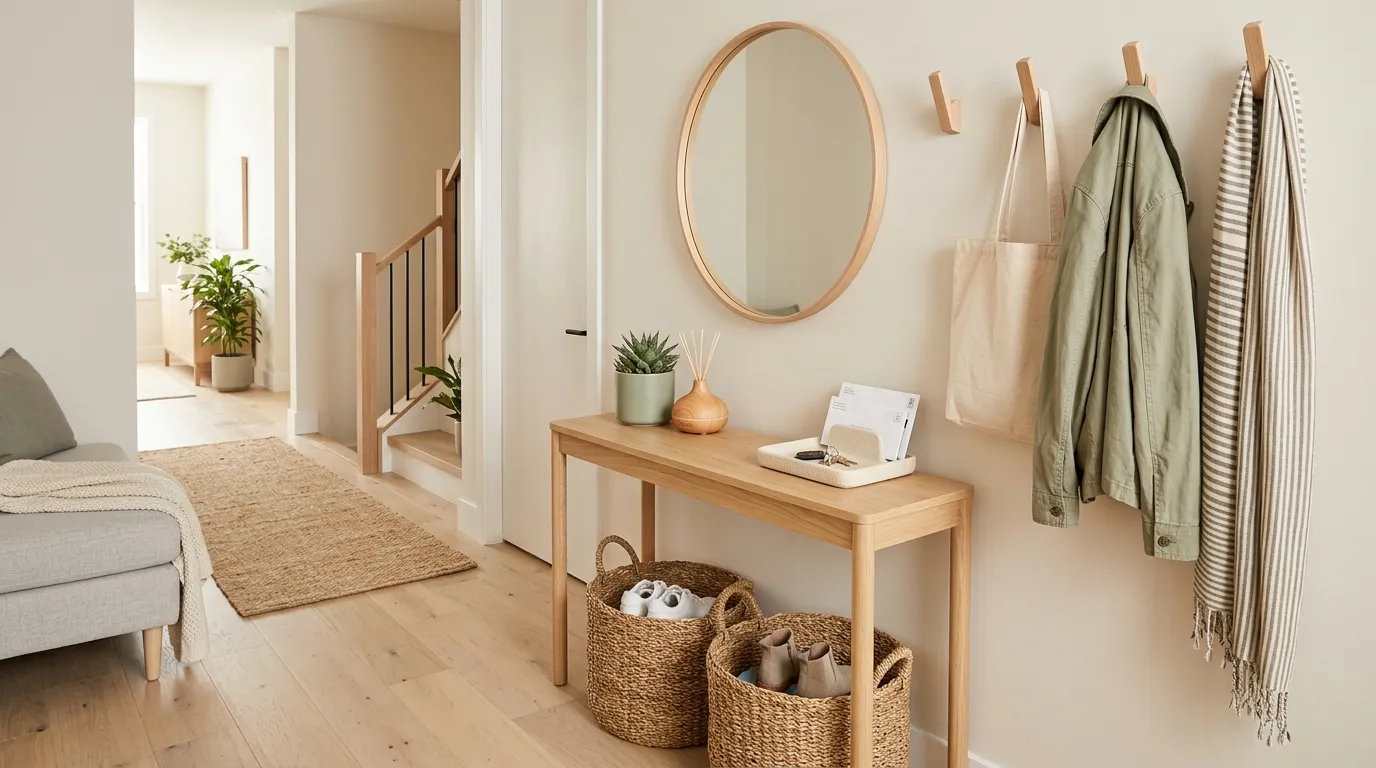
Table of Contents
What does a functional entryway require? Four things: a fixed home for keys, a place for shoes that keeps them off the floor, wall hooks for bags and coats, and a mail station to intercept paper before it spreads. Those four zones handle 80% of all entryway clutter. Everything after that is refinement.
The entryway is the daily pinch point of your household. Keys that cannot be found at 8am. Shoes kicked in front of the door. Bags balanced on the nearest counter. Mail stacked on the floor.
None of this is a character flaw—it happens because the space has no system. Once you give these four categories a designated home, the morning chaos dissolves almost automatically.
The 4 Non-Negotiable Entryway Zones
These four zones apply whether your entryway is a proper mudroom with built-in cubbies or a 3-foot section of wall next to your apartment door.
Zone 1: Key Station
Keys need a single, visible, fixed home within arm's reach of the door. A wall-mounted hook rack works for households with multiple sets of keys. A small ceramic bowl or tray on a console table works for simpler situations.
The only rule: keys go here the moment you walk in the door. Not on the counter, not in a jacket pocket, not set down temporarily. The moment you walk through the door. This habit alone eliminates the "I can't find my keys" problem entirely.
Zone 2: Shoe Storage
Shoes on the floor are the most visually impactful form of entryway clutter. Even two pairs create the impression of disorder.
Options by space available:
| Space | Solution |
|---|---|
| Dedicated mudroom | Built-in cubbies with one section per household member |
| Small entry with floor space | Storage bench with cubbies or lift-up seat |
| Tight entry with no floor space | Slim wall-mounted shoe rack, vertical format |
| Apartment door | A small tray or step stool as a visual boundary for two pairs max |
Zone 3: Coat and Bag Hooks
A row of wall hooks is the highest return-on-investment entryway purchase. Install at two heights—adult height and child height—and assign one or two hooks per household member.
Do not buy a single-hook standalone rack. It holds one coat and immediately becomes overloaded. A row of 4 to 6 individual hooks screwed directly into a wall stud can support real daily use.
Zone 4: Mail and Paper Station
A wall-mounted mail sorter with three labeled slots—To Do, To File, Outgoing—intercepts paper before it hits every horizontal surface in your home. Place a small trash bin or recycling slot directly beneath it for immediate junk mail disposal as you walk through the door.
Small Entryway: No Dedicated Space
If your front door opens directly into your living room or a very small foyer, these solutions fit in as little as 2 to 3 feet of wall.
- Wall-mounted hooks — keep everything vertical and off the floor
- A narrow console table (12 to 14 inches deep) — provides a surface for keys and a lamp, with shelf space below for shoes or a basket
- Over-door hooks — if there's a closet near the entry, the inside of its door can hold coats without touching any wall space
- A single small tray — use it as the key station and the mail landing zone simultaneously; process it weekly
Family Entryway: Multiple People, Multiple Items
Children multiply entryway chaos reliably. The solution is identical to adult zones but smaller and lower: one hook per child, one cubby or basket per child, labeled.
For younger children, add their photo or a picture label above their hook and cubby. They recognize the image before they can read the name, which makes the system self-maintaining even for toddlers. For related systems that work in children's spaces, read our Kids' Bedroom Organization Guide.
Seasonal Maintenance
An entryway system that works in July does not automatically work in January. Twice a year, spend 15 minutes:
- Swapping heavy winter coats for lighter jackets (or vice versa)
- Adding or removing a boot tray near the door for wet weather
- Checking that each zone still has adequate hooks, hooks are at the right height, and no category has overflowed its space
Frequently Asked Questions
How do I organize a small entryway with no closet?
What should actually be stored in an entryway?
How do you prevent the entryway from becoming a dumping ground?
How many hooks does an entryway actually need?
Join Organized Haven
Get weekly home organization tips, DIY décor ideas, and exclusive printables delivered straight to your inbox. Join 10,000+ homeowners today!
We respect your privacy. Unsubscribe at any time.
Written by Danilo Souza
Danilo Souza is a Home Organization Expert and Interior Decor Specialist with over 8 years of experience in transforming cluttered, stressful rooms into functional, peaceful, and beautifully designed living spaces. His practical, step-by-step methodologies empower homeowners to create lasting organizational systems that fit their lifestyle and budget.