Organize Tupperware and Food Containers
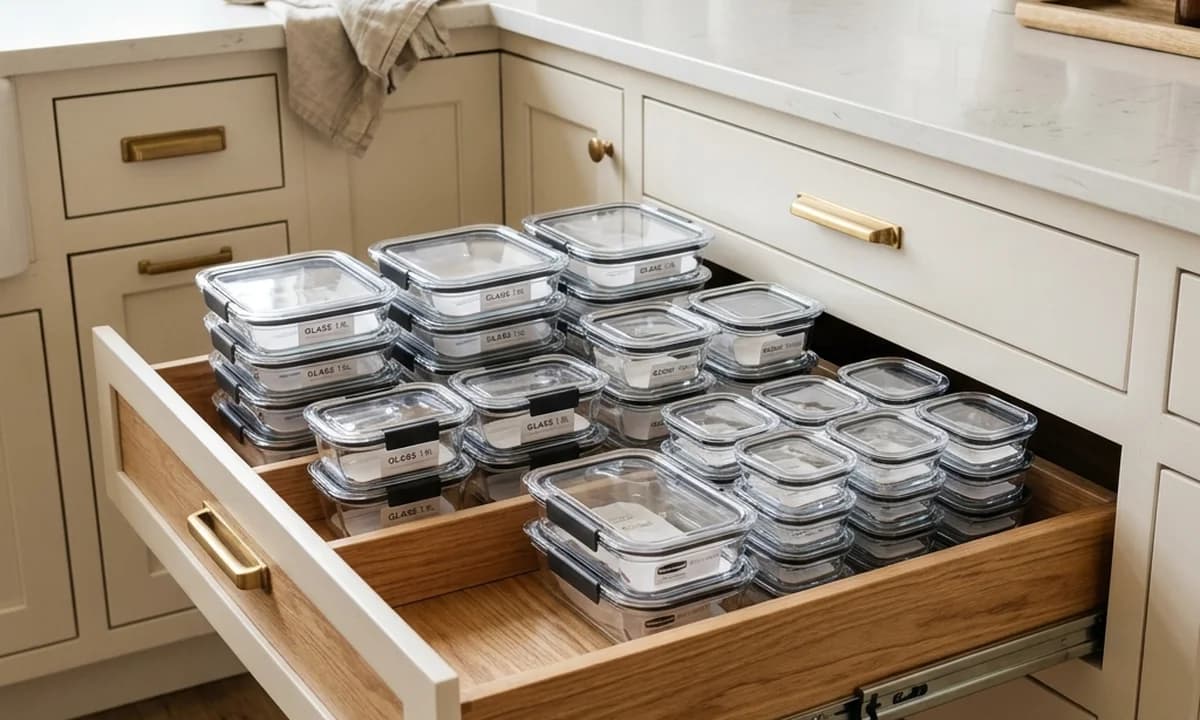
Table of Contents
Why does the food container cabinet always become chaotic? Because it contains incompatible inventory. Takeout containers, old plastic sets from different brands, and glass containers stack poorly together—they slide, topple, and resist nesting. The permanent fix is two-part: ruthlessly purge mismatched items and store bases separately from lids (lids stored vertically in their own container). No other change matters until these two are in place.
The food container cabinet starts organized and becomes a problem within a few months. Not because the system failed—because the inventory changed. A new takeout container arrives, a lid gets melted on the bottom rack of the dishwasher, two containers from different sets end up together. Incompatible items do not nest, and things that don't nest stack in unpredictable ways that topple.
Here is the complete reset process.
Step 1: Empty, Match, and Purge
Pull everything out of the cabinet and onto the kitchen table. This is the only way to see the full inventory at once.
The Match Game: Match every lid to its corresponding base. Work through the pile until everything is paired or unmatched.
The purge rule:
- Any base without a lid: recycle or trash
- Any lid without a base: recycle or trash
- Anything warped, cracked, or heavily stained with set-in tomato sauce: trash
- Anything not used in the past 6 months with no foreseeable use: donate or trash
Be specific about "foreseeable." A container used once a year at holidays earns its spot. A container you have been "going to use" for two years does not.
After the purge, the volume of containers in the cabinet typically drops by 30 to 50%. This alone often solves the problem.
Step 2: Consider Committing to One Set
The most effective long-term solution is replacing mismatched inventory with one or two uniform matching sets. When containers are from the same product line:
- Bases nest together by design—multiple sizes stack into one compact column
- Lids are often interchangeable across sizes
- The stacking pattern is stable and predictable
The Rubbermaid Brilliance line, Pyrex Snapware, and OXO Good Grips containers are commonly recommended because of their precise lid fit and stackability. Investing $30 to $60 once to eliminate the cabinet problem permanently is worth it for most households.
Step 3: Store Bases and Lids Separately
This is the step most people resist and the step that matters most.
Storing containers with lids snapped on wastes significant vertical cabinet space—each sealed container is twice the height it needs to be. And when lids are snapped on, you cannot nest containers of the same size inside each other.
How to store bases: Group by shape (squares together, rounds together, rectangles together), then nest from largest to smallest. The entire collection compresses into 3 to 4 stacked columns taking up a fraction of a single shelf.
How to store lids: File vertically—like albums in a record crate or books on a shelf—never in a horizontal stack. Three options:
- Plate or bakeware rack: A wire rack holds stiff glass and hard plastic lids upright in individual slots
- Spring-loaded drawer divider: Creates a narrow channel in a deep drawer for lids to stand in a line
- Acrylic pull-out bin: Drop all lids upright into a bin that slides out like a drawer from the shelf—you flip through them like folders to find the right size
Step 4: Use the Cabinet Door for Lids
If the cabinet shelf is fully occupied by nested bases and there is no room for a lid bin, the back of the cabinet door is dead space.
A lightweight wire magazine file or an adhesive-mount clear organizer mounted inside the cabinet door holds smaller, lighter plastic lids vertically, completely out of the shelf space and instantly accessible when the door opens.
Frequently Asked Questions
Should Tupperware be stored with lids on or off?
How do I keep different brands of containers organized together?
Are glass food containers worth switching to from plastic?
Join Organized Haven
Get weekly home organization tips, DIY décor ideas, and exclusive printables delivered straight to your inbox. Join 10,000+ homeowners today!
We respect your privacy. Unsubscribe at any time.
Written by Danilo Souza
Danilo Souza is a Home Organization Expert and Interior Decor Specialist with over 8 years of experience in transforming cluttered, stressful rooms into functional, peaceful, and beautifully designed living spaces. His practical, step-by-step methodologies empower homeowners to create lasting organizational systems that fit their lifestyle and budget.