Living Room Organization for Small Spaces
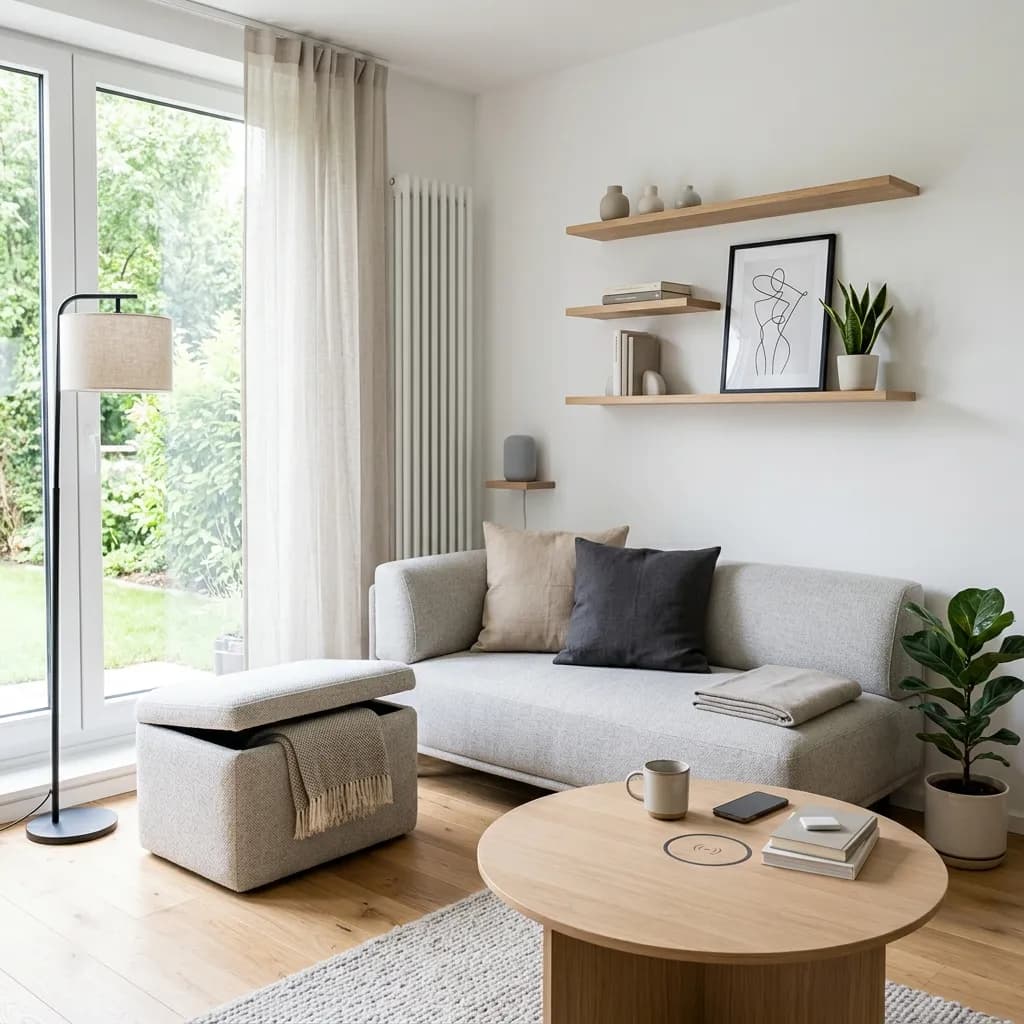
Table of Contents
- 1. A Storage Ottoman Instead of a Coffee Table
- Coffee Table Options for Small Living Rooms
- 2. Floating Shelves on the Walls
- 3. A Media Console with Solid Doors
- 4. Baskets Inside Open Shelving
- 5. Cable Management
- 6. Side Tables with Drawers
- 7. The "One In, One Out" Rule for Décor
- 8. A Drop Zone Near the Entry
- 9. A Tray for Remotes and Daily Items
- 10. The Monthly Living Room Reset
How do you keep a small living room organized? The most effective strategy is multi-function furniture with hidden storage (storage ottomans, media consoles with doors) combined with vertical storage that draws the eye up (floating shelves). Keep the floor completely clear at all times—in a small living room, a clear floor doubles how spacious the space feels.
Research from the Princeton University Neuroscience Institute found that visual clutter in your immediate environment directly competes for your attention, reducing focus and increasing stress. In a small living room, that effect is amplified because the clutter is unavoidably visible from anywhere in the room.
The good news: small living rooms actually become organized faster and stay organized more easily than large ones—because there is less surface area for clutter to accumulate. The key is using the right furniture and enforcing a few strict rules.
1. A Storage Ottoman Instead of a Coffee Table
In a small space, furniture must earn its footprint. A large storage ottoman does three jobs simultaneously: coffee table (with a tray on top), extra seating when you have guests, and hidden storage for throw blankets, board games, and the remote control.
Coffee Table Options for Small Living Rooms
| Type | Storage | Visual Weight | Best For |
|---|---|---|---|
| Storage Ottoman | High (deep cavity) | Medium | Blankets, games, hiding toys |
| Nesting Tables | None | Very light | Flexibility, easy rearranging |
| Lift-Top Table | Medium (shallow tray) | Medium | Laptops, remotes, magazines |
2. Floating Shelves on the Walls
When floor space is limited, your walls are your most underutilized asset. Floating shelves installed above the sofa or along an empty wall hold books, plants, decorative objects, and practical items (a small charging station, a speaker) without consuming a single square foot of floor space.
The secondary benefit: wall shelves draw the eye upward, making a low ceiling feel taller.
3. A Media Console with Solid Doors
Open-shelving media consoles look intentional in design magazines and turn into chaotic cable tangles within two weeks in real life. A media console with solid doors hides every gaming console, DVD player, router, and cable management solution completely while keeping everything accessible.
4. Baskets Inside Open Shelving
If you already have a bookcase with open shelves, add matching fabric or rattan baskets to the lower shelves. These corral the items that would otherwise sit loosely: extra cables, kids' toys, dog accessories, mail you haven't dealt with yet. The basket becomes the category; anything in that category lives in that basket.
5. Cable Management
Visible cords and power strips are among the most common sources of visual chaos in a living room. Two options:
- Cable management box: A decorative box that hides a power strip and all the cords plugged into it. Place it behind the TV stand.
- In-wall kit: A weekend project that routes TV and cable cords through the wall so nothing is visible behind a mounted TV.
6. Side Tables with Drawers
Most side tables are a flat top on four legs. A side table with one or two drawers provides a hidden home for the items that accumulate on every flat surface: lip balm, phone chargers, TV remotes, a book you're halfway through. When guests arrive, close the drawer.
7. The "One In, One Out" Rule for Décor
Small living rooms become overwhelmed by decorative objects very quickly. For every new item you bring in—a throw pillow, a vase, a coffee table book—one existing item leaves. No exceptions. This is not about minimalism as an aesthetic; it is about maintaining a functional space that doesn't trigger the clutter-induced stress response documented in the neuroscience research above.
8. A Drop Zone Near the Entry
If your front door opens directly into or adjacent to your living room, the absence of a designated drop zone will result in coats on the sofa, keys on the coffee table, and bags on the floor. Install two hooks and a small floating shelf on the wall immediately inside the door.
9. A Tray for Remotes and Daily Items
Remotes, coasters, phone chargers, and a half-empty lip balm tube are the four items most likely to be visually scattered across every surface in your living room. A single clear acrylic tray or a small decorative bowl on the coffee table gives these items a permanent, defined home. When the tray is full, nothing new goes on the coffee table.
10. The Monthly Living Room Reset
Clutter returns slowly, imperceptibly, until one day it's suddenly everywhere again. A 15-minute monthly reset—clearing old magazines, returning items that have migrated from other rooms, wiping down shelves—prevents gradual accumulation from compounding into a multi-hour cleaning project. For more on maintaining all the rooms in your home with minimal effort, read our Ultimate Home Organization Guide.
Frequently Asked Questions
How do you hide clutter in a small living room?
Where should I store kids' toys in a small living room?
How can I make a small living room look bigger and less cluttered?
What is the best way to organize TV cables and cords?
Join Organized Haven
Get weekly home organization tips, DIY décor ideas, and exclusive printables delivered straight to your inbox. Join 10,000+ homeowners today!
We respect your privacy. Unsubscribe at any time.
Written by Danilo Souza
Danilo Souza is a Home Organization Expert and Interior Decor Specialist with over 8 years of experience in transforming cluttered, stressful rooms into functional, peaceful, and beautifully designed living spaces. His practical, step-by-step methodologies empower homeowners to create lasting organizational systems that fit their lifestyle and budget.